
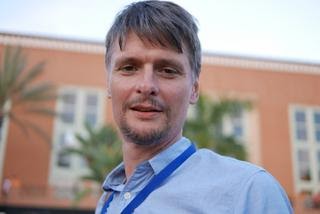
Neil Lawrence joins the CDEI advisory board
Neil Lawrence was appointed a member of the Centre for Data Ethics and Innovation advisory board.

12 September 2026
12 September 2026
On 12 September Neil Lawrence was a guest on BBC World Service Weekend, across three editions presented by Paul Henley. Leslie Vinjamuri, president of the Chicago Council on Global Affairs, was the other guest. The programmes are on BBC Sounds until 2 October:
The editions moved through the week’s news. Iranian-backed Houthi fighters had taken Yemen’s Red Sea coast. Saudi Arabia had shut its east–west oil pipeline after drone attacks. Presidents of Russia, China and Iran were gathering in India for a BRICS summit already split over the Middle East. There was also a discussion with Ben MacIntyre about his book Redwood. It tells the story of a Russian spy who betrayed his service for his private life. Other items included the legacy of 11 September, twenty-five years on and the first anniversary of the murder of Charlie Kirk.
Two AI stories were covered. OpenAI had announced that about 10,000 agents, working for roughly 88 hours, had made progress on the Navier–Stokes existence and smoothness problem, one of the Millennium Prize problems. The claim covered two of the four statements the prize requires, and OpenAI said it was not claiming the prize. Mathematician Tristan Buckmaster disputed the credit, arguing that the work drew on results he and Levent Alpöge already had in hand. The other story was Jacob Coxon, the former Anthropic researcher, telling the BBC that if the present rate of progress is not slowed there is a strong chance we could all die in the immediate future.

25 January 2022
Neil Lawrence was appointed a member of the Centre for Data Ethics and Innovation advisory board.

15 February 2022
The Data Trusts Initiative is pleased to introduce our first cohort of data trust pioneers who will be leading the creation of real-world data trusts in 2022.

3 May 2022
Neil Lawrence gave the Strachey Lecture in Computing Science at the University of Oxford, arguing that to control machine intelligence we first need to understand how it differs from our own.